Tuesday, 31 October 2017

ASIA TIMES : Eye on Catalonia, South Thailand yearns to vote

http://www.atimes.com/article/eye-catalonia-south-thailand-yearns-vote/

Malay Muslim activists in the insurgency-prone region have called for a referendum on 'rights to self-determination', a rally cry military authorities have curbed and silenced

 YALA, OCTOBER 31, 2017 3:48 PM (UTC+8)
An artist takes part in a graffiti event as part of the Saiburi Street Xhibit in Pattani - one of Thailand's southernmost Muslim majority provinces hit by a deadly insurgency - on February 28, 2016. Photo: AFP/Madree Tohlala

Thursday, 12 October 2017

Deadly bombings dim peace prospects in Thailand's Deep South

Dominant insurgent group BRN wants more say in negotiations with the generals in Bangkok
Deadly bombings dim peace prospects in Thailand's Deep South
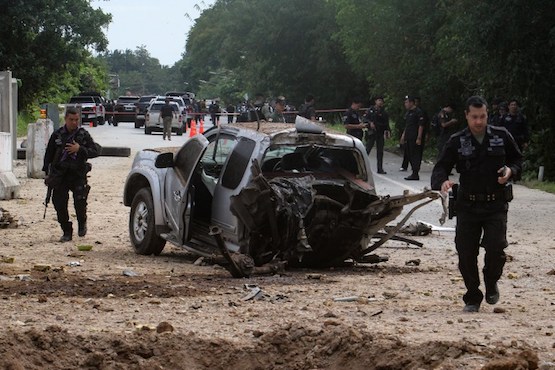
Thai army rangers walk through the scene of a roadside bomb which killed four army rangers in the restive Southern Thai province of Pattani on Sept. 22. (Photo by Tuwaedaniya Meringing/AFP)
https://www.ucanews.com/news/deadly-bombings-dim-peace-prospects-in-thailands-deep-south/80438

October 11, 2017

The bomb blast was so powerful that it ripped in half the pickup truck carrying a group of Thai soldiers, killing four of them and wounding five others and a civilian. 
The insurgents had taken advantage of road construction in Sai Buri district in Pattani Province and planted a 100-kilogram bomb inside drainage pipes at a construction site. Two of the injured died in a Pattani hospital the following day.
Pattani is one of the three Muslim-majority provinces in Thailand's Deep South where nearly 7,000 lives have been claimed since a violent insurgency started in January 2004.
What upset the Thai officials over the Sept. 22 bombing, like many other previous attacks, was the refusal of locals to come forward with information. Popular support for the separatist militants at the grassroots level remains high.
A week earlier, on Sept. 14, insurgents carried out a double bomb attack in Yala's Yaha district, killing two security officials. At least 18 others were wounded by the blast.
Most of the victims attack were members of an army bomb squad who were on their way to inspect a power pole that was brought down the night before by an explosive device. It was a ploy luring them to the scene where the much bigger second bomb awaited them.
A month earlier, on Aug. 16, there was the carjacking of seven pickup trucks from a local second-hand dealer. The vehicles were intended to be used as car bombs.
When four hostages tried to escape, one of their abductors pulled out a gun and fired at them. One of the hostages died in hospital later in the day, while another survived with a bullet wound to the shoulder. The three survivors went straight to the police and soon after, the entire security apparatus in the region went on high alert.
The operatives scaled back their goals. Only two of the seven vehicles were used as car bombs. One hit an army vehicle and another was detonated at an apartment building for police officers.
Indeed, it has not been a good period for the Thai security apparatus. The beating that they have been taking has cast a dark cloud over an agreement that the Thai negotiators reached with the Barisan Revolusi Nasional (BRN).
Leaders of the BRN informed the Malaysian facilitator of the agreement that their combatants would not sabotage the much talked about "Safety Zone" project between Bangkok and MARA Patani, an umbrella organization of Deep South separatist movements. A verbal agreement was given by the BRN to the Malaysian facilitator two months ago towards the end of the Ramadan.
The Safety Zone refers to a provincial district where a ceasefire is to be observed. The BRN — the dominant insurgent organisation that controls virtually all militants on the ground — is not part of MARA Patani.
The verbal promise from the BRN, which included not sabotaging the Thailand-MARA Patani talks, was greatly welcomed by Bangkok and Kuala Lumpur.
But BRN militants on the ground said there is plenty of bad blood between them and MARA Patani. BRN militants suggested in an interview with me on Sept. 30 that the Safety Zone project will not have smooth sailing. They insisted that they should be the ones who Bangkok should be negotiating with, not MARA Patani. Their reasoning was based on the fact that they control the militants on the ground.
Bangkok has taken the warning seriously and decided to postpone the announcement of which district in the Deep South would be designated as a safety zone.
Discussions among BRN cadres on the ground and abroad over the past month have centered on the cost-benefit ratio behind the continuation of discrediting Bangkok and MARA Patani.
Acknowledging the bad blood stemming from competition between them and MARA Patani, some mid-ranking progressive BRN members are calling on the movement to move on from tit-for-tat attacks that may discredit the official dialogue process between the Thai government and MARA Patani but does little to advance BRN's cause and agenda.
The BRN source said his militant group is focusing more on how to engage the global community to learn about international norms and best practices. He also said understanding among the BRN about how to conduct proper negotiations is lacking and added that their negotiators will not come to the table until they are properly trained.
A Thai Army forensic team member inspects the site of a roadside bomb blast that targeted a Thai army patrol in southern Thailand's Pattani province on June 19. Six soldiers were killed by the explosion. (Photo by Tuwaedaniya Meringing/AFP)

Yingluck Shinawatra peace initiative
Peace talk proposals were initiated by the government of Yingluck Shinawatra in Feb. 28, 2013. The initiative came across as a big leap of faith by many observers. For the BRN, it was more like a hoax. Yingluck was ousted from power in May 2014 and her peace initiative came to a standstill.
The Thai junta announced in December 2014 that talks with the Patanni Malay rebels with Malaysian facilitation would continue. In August 2015, MARA Patani was introduced to the public at a press conference in Kuala Lumpur. Like Yingluck's peace initiative, this one didn't have the endorsement or participation of BRN either.
Thai officials said they were fully aware that members in MARA Patani did not control the insurgents but justified the dialogue with the umbrella organisation by saying they were hopeful the BRN would eventually join in.
Like the Yingluck initiative, the junta had also taken a big leap of faith, hoping that one day, that Malay Muslim residents at the grassroots level would become tired of the violence and end their support for the BRN.
But more than four years after Yingluck launched her peace initiative, there is no indication that such support for BRN has diminished or that the intensity of their attacks will lessen.
The BRN have said they will come to the table only when they are ready, which means proper training and a better understanding of the international norms for members of their political wing.
The militant group said the ball is in Thailand's court and it is up to the generals in Bangkok to decide whether they are willing to internationalize the peace initiative in exchange for getting their representatives to the talk.
But so far, Thailand has not given any indication that it is willing to permit foreign assistance, much less make any concession to the BRN or the Malays of Patani.
"The junta is very worried about their legacy," said one Thai security officer who monitors the situation closely. "They don't want to be remembered as the guy who gave away Patani," added the source, referring to the contested Malay historical homeland that is now part of Thailand's southernmost provinces.
Don Pathan is an independent security analyst based in Thailand. He is also a founding member of Patani Forum, a civil society organization dedicated to promoting critical discussion on the conflict in Thailand's Far South.


Tuesday, 5 September 2017

Deep South Peace Talks: Car-Jacked?

Commentary by Don Pathan
Yala, Thailand

BenarNews

Roadside blast that killed six Thai soldiers in Pattani, June 19, 2017. AFP
In June, near the end of the Muslim fasting month of Ramadan, Ahmad Zamzamin Hashim, the Malaysian mediator of the Southern Thailand peace process, invited the Barisan Revolusi Nasional (BRN) to join the negotiations.

It was not the first time that such an invitation had been extended to the BRN, the most powerful insurgent group operating in southern Thailand. But, this time around, Zamzamin had reason to be optimistic.

At stake was the resolution of a 13-year-old armed conflict that has killed nearly 7,000 people in Thailand’s southernmost provinces of Pattani, Yala and Narathiwat – areas that were part of a Malay Muslim sultanate before being annexed by Bangkok in 1909.

Malaysia is facilitating the negotiations between Bangkok and MARA Patani, an umbrella organization of southern insurgent groups.

In response to Zamzamin’s invitation, Doonloh Wae-mano (alias Abdullah Wan Mat Noor), the most senior official of BRN’s governing council, said he and his people “would have to think about it.”

Zamzamin also had assurances from the BRN that it would not sabotage the safety zone initiative, a limited ceasefire being planned in designated areas in Thailand’s three Muslim-majority provinces, collectively known as the Deep South.

This point was discussed during the Aug. 8 to 10 meeting between MARA Patani and Thai negotiators in Kuala Lumpur, sources said.

But on Aug. 16, less than a week after the conclusion of that meeting, seven young militants stole pickup trucks and snatched hostages from a second-hand car dealership in Songkhla province, just north of the Deep South.

Their plan – to convert the vehicles into car bombs – fell apart after four hostages tried to escape. Two hostages were shot, one died in hospital, and the survivors alerted authorities. The entire region went on high alert.

In the end, only two of the seven pickup trucks were used as car bombs, and a suspected militant died after an alleged shootout with Thai police.

Army chief Gen. Chalermchai Sitthisart said the seven militants were directed by Wae-mano – taking a jab at the man believed by many Thai officials to be the biggest obstacle to BRN joining the peace talks.

The carjackings dampened the optimism felt after BRN agreed not to sabotage the safety zone initiative – and served as a reminder that nothing comes easy in Thailand’s Deep South.

The next round of talks are expected this month, but MARA Patani has asked for more time to prepare for the meeting, which had been scheduled for Sept. 11, a Thai government official said.

‘Bad blood’

For their part, BRN sources said the chain of command in their movement is fluid, meaning that deals reached at the top level may not play out on the ground the way that Thai or Malaysian officials want them to.

Moreover, said the sources, there is bad blood between the BRN and MARA Patani, and this will take time to overcome.

“Pohsu Loh [Wae-mano] was being polite and diplomatic when he said BRN would refrain from hitting districts designated as Safety Zones. BRN has cells in just about every tambon [sub-district] and it remains to be seen how this agreement or understanding with Ahmad Zamzamin will play out,” said one BRN source, who added that his unit had not been informed of this particular deal.

BRN officials say Bangkok’s insistence that talks be in line with the country’s constitution, which clearly stipulates that the kingdom is indivisible, has always been a non-starter.

They say they would hypothetically be willing to talk to the government if that stipulation was not raised, and in turn, they would not mention the issue of independence.

BRN officials also say they will only come to the table if their negotiators are properly trained, and the talks are mediated by the international community – in line with peace processes in the southern Philippines and in Aceh, Indonesia.

A Thai military intelligence officer who monitors the Deep South conflict said involving the BRN would be an opportunity to talk to the people who have command-and-control over the militants.

In June, Deputy Defense Minister Udomdej Sitabutr publicly implied that MARA Patani may not be the right dialogue partners. In other words, he doesn’t believe MARA Patani has command-and-control over the insurgents engaged in the fighting.

But Udomdej’s statement was said to have rubbed Gen. Aksara Kerdpol, Thailand’s chief negotiator, the wrong way.

Aksara and many in the Thai government, including Prime Minister Prayuth Chan-o-cha, believe that if the “real” BRN wants to join the talks, they need to come under MARA Patani’s umbrella, not start a new track.

Tit-for-tat

Even if the Thai military allows the presence of international participants, there is no indication that it would be willing to make concessions touching on the historical root causes and the deep-seated mistrust between the Thai government and the Malays of the Deep South.

BRN also pointed to the Thai government’s refusal to grant legal immunity to two MARA Patani negotiators as a sign of Bangkok’s unwillingness to make concessions.

Sukree Hari and Ahmad Chuwol, who fled Thailand in 2007 after posting bail under the then-military government, resurfaced as MARA Patani members when the panel was launched in August 2015.

The two requested the immunity that would permit them to return to Thailand and observe the safety zone pilot project, one source said. But the Thai Justice Ministry was firmly against it for fear that it would create an unwanted precedent.

Moreover, allegations of extra-judicial killings by both sides continued to dampen the atmosphere at the political level and set off tit-for-tat revenge killings.

Don Pathan is a Thailand-based security analyst and consultant. The opinions expressed in this commentary are those of the author and not of BenarNews.

http://www.benarnews.org/english/commentaries/far-south-view/car-jack-09052017165442.html


Monday, 21 August 2017

Bold car-bomb plot exposed security failures in South

DON PATHAN
SPECIAL TO THE NATION
Aug 20, 2017

ON THE SURFACE, the incident on August 16 came across as a spectacular operation – seven separatist insurgents swooped on a second-hand car dealer in one of the conflict-affected districts of the far South to steal six vehicles for use as car bombs on the very same day.

Police flats in Mayo district hit by a car bomb, Aug 17, 2017. (Nationphoto)


Needless to say, the incident sent shock waves around the country. And in keeping with the usual knee-jerk reactions of senior Thai security officers, all sorts of off-the-mark statements were issued. Some suggested a “new generation” of fighters had emerged, while others were taken aback by the insurgents’ audacity, calling it a “new” development. First of all, no one doubts the boldness and audacity of the operation. But what was relatively “new” on this occasion was that the insurgents combined hostage taking and car stealing.

Over the past 16 months, there have been four incidents of insurgents stealing vehicles and using them as car bombs the same day. The most recent one was the Big C car bomb in May this year that injured scores of onlookers who paid for their curiosity despite prior warnings in the form of a “smaller bomb” by the insurgents.

In February 2016, seven policemen were injured in a car-bomb attack near the Border Patrol Police base in Pattani’s Tambon Rusamilae. A Honda Jazz was stolen from the same district that day. In August 2016, an ambulance van was stolen from a tambon in Pattani and hours later used as a car bomb at the Southern View Hotel.

And in April 2016, three suspects carjacked a pickup truck, packed it with explosives and forced its owner to drive it into the heart of Yala while holding his wife as hostage. The plan fell apart as the driver abandoned the bomb-laden vehicle and ran for help. The insurgents didn’t go through with the threat and released the wife unharmed.

Deputy Defence Minister Udomdej Sitabutr blamed the August 16 operation on Barisan Revolusi Nasional (BRN), one of the long-standing separatist movement that controls virtually all the combatants on the ground. He added that security lapses in the far South permitted insurgents to carry out attacks against government troops.

Army chief General Chalermchai Sitthisad dubbed the insurgents involved in the August 16 operation as a “new generation” of militants lured by money and under the control of Abdulloh Waemanor, an exiled headmaster of an Islamic boarding school, who Thai authorities believe controls the military wing of the BRN.  But if the Thai military intelligence is to be believed, then all Patani Malay combatants act under Waemanor’s directive. One has to wonder about the merit of his statement.

Thai Army sources said Chalermchai wants to put Waemanor in the spotlight to pressure him to endorse the ongoing peace dialogue between Bangkok and MARA Patani, an umbrella organisation made up of various long-standing Patani Malay separatist movements. Sadly, the military thinks it is only dealing with disgruntled Malays with guns and conveniently overlooks the historical root causes of the conflict.

The insurgents behind the August 16 operation were “new” only because they were not on the blacklist of any of the security agencies in the far South. Authorities quickly learned this reality when they were unable to match the faces of the suspects with anybody in their files.  And so when the top brass in Bangkok demanded some answers about the identity of these young men in black who were driving around in seven stolen vehicles, the officers at the operational level conveniently referred to them as “new faces”.

Although the act of stealing cars and using them as car bombs is not new, the militants’ August 16 operation by itself was a disaster.  Each of the six vehicles stolen from the dealer was driven by one suspect. The first vehicle, a Toyota Vigo, was packed with explosives and set off on Highway 418 in the vicinity of Pattani’s Nong Chik district, targeting a moving military vehicle. Four soldiers from a medical unit suffered minor injuries.

The second vehicle, a Mitsubishi Triton, ran out of petrol and was abandoned in Songkhla’s Thepa district, not far from the original crime scene, while the third pickup truck, an Isuzu Dmax, was abandoned in Pattani’s Tambon Klong Maning.  The fourth vehicle, a Dmax, was abandoned in a rubber plantation in Pattani’s Khok Pho district and the fifth, also an Isuzu Dmax, packed with a home-made bomb, crashed through a security checkpoint. But the vehicle was eventually hunted down and the suspected insurgent killed in a gunfight with the police in Nong Chik.

The sixth vehicle, an Isuzu Cab, was used as a car bomb in an attack on police homes in Pattani’s Mayo district. The seventh vehicle, a Mazda, was also and was left abandoned in Tambon Chanae in Songkhla’s Sabayoi district, with three gallons of petrol inside. It was this vehicle that transported the four from the auto dealer to a nearby wooded area where they were supposed to be executed.

The first victim was shot in the head and later died in hospital. The second survived a shot to the shoulder while the other two wrestled their way out and succeeded in escaping from the gunman.

In the end, only two of the six vehicles were turned into car bombs. The rest were abandoned, possibly because of the quick reaction by the authorities, who had been alerted to the robbery by the escaped hostages. Perhaps the insurgents had aimed too high, hence their failure to pull off more car bomb attacks. Perhaps our top brass were too panicky and tried too hard to sound like they were on top of things.

DON PATHAN is a consultant and member of the Patani Forum (www.pataniforum.com), a civil society organisation dedicated to promoting critical discussion on the insurgency in Thailand’s Malay-speaking South.  

http://www.nationmultimedia.com/detail/politics/30324332

Friday, 18 August 2017

Thailand eyes next moves in southern peace talks


https://asia.nikkei.com/Viewpoints/Don-Pathan/Thailand-eyes-next-moves-in-southern-peace-talks?n_cid=NARAN012

August 17, 2017 12:30 pm JST
Don Pathan

Thailand eyes next moves in southern peace talks

Military leaders and Islamist insurgents must compromise to end violence
Thai army soldiers search the area of a roadside bomb blast in the southern province of Pattani, Thailand, June 19, 2017. © Reuters
Four years on from the launch of peace talks aimed at ending a separatist insurgency in Thailand's three southernmost provinces, progress is moving at a snail's pace. Some critics say that both the Thai government and Islamist militants appear to be going through the motions of a bogus peace process.
Both sides need to find a fresh approach. Divisions among the insurgents need to be overcome, allowing collective negotiations with the Thai government, and the ruling junta needs to stop ignoring the cultural and historical grievances between the population of the South and the Thai state. There must also be justice for innocent civilians killed and injured by both sides.
https://asia.nikkei.com/Viewpoints/Don-Pathan/Thailand-eyes-next-moves-in-southern-peace-talks?n_cid=NARAN012

Wednesday, 24 May 2017

Three years after coup, peace remains elusive in southern Thailand

Don Pathan
The Nation

EVEN though the National Council for Peace and Order (NCPO) did not cite the conflict in the far South as one of the reasons for launching a coup three years ago, the generals nevertheless inherited a mess of a challenge as they decided to continue with the peace initiative with the separatists initiated by the previous government.

The then-prime minister Yingluck Shinawatra kicked off her peace initiative on Feb 28, 2013, one year after her fugitive brother, Thaksin — with the help of his associates and cronies — paved the way for the official launch.

The Thai army was more or less kept in the dark throughout the entire planning and preparation process. The same goes for the Barisan Revolusi Nasional (BRN), the one long-standing separatist movement that today controls virtually all militants on the ground, which was pretty much caught off-guard when the initiative was officially launched.

Hasan Taib was designated as the “liaison” by Thailand and Malaysia; his job was to convince all other long-standing separatist groups and leaders, especially members of the secretive BRN ruling council, to come to the negotiating table. When it was clear that the BRN wouldn’t budge, Hasan threw in the towel and went incommunicado.

At about the same time, the government in Bangkok went into a tailspin as “Shutdown Bangkok” set the stage for a coup in May 2014.

While the generals did not create the February 2013 peace initiative, they were stuck with this hot potato, and some wanted to scrap it altogether.

In the end, after nearly seven months of deliberation, Prime Minister Prayut Chan-o-cha went to Kuala Lumpur to meet his Malaysian counterpart Najib Razak and formally request that Kuala Lumpur continue to act as the facilitator for the talks.

Security planners in Bangkok do not see Malaysia as an honest broker but rather as a stakeholder. But that is all the more reason for the Malaysians to be at the table.

Having three stakeholders in the talks with no neutral mediator would prove to be a disastrous endeavour given the historical mistrust among the three parties that still prevails.

The NCPO asked that a new phase of talks be inclusive, meaning all the long-standing separatist groups working under one common platform.

The junta also wanted to be sure that they were talking to the right people, and that participants at the talks could prove they had command-and-control on the ground. Their short-term goal was to reduce violence on the ground.

The problem with the Thai generals was that they were not interested in making concessions or addressing the historical grievances of Patani Malays. Their aim was to get the “real guys” to the table and go from there, they thought.

BRN members said the junta was only concerned with its own legacy and did not want to be seen as the people who “gave away Patani”, so they were not about to give much legitimacy to whoever came to the table.

By August 2016, MARA Patani, an umbrella organisation made up of long-standing separatist groups, was introduced to the public at a press conference in Kuala Lumpur. It was billed as a platform for the separatists to make their case. The focus of attention was on a group of young religious teachers who participated under the BRN banner.

But BRN operatives on the ground and abroad insisted these few self-proclaimed “BRN leaders” did not have the mandate of the group’s ruling council. The BRN information department would issue a rare public statement late last year to say that they were not involved in this peace initiative. They issued a similar statement last month to say much the same thing, reiterating that any talk with the Thais must be observed by foreign governments.

Like previous Thai governments, the current junta wanted to treat the dialogue process as a domestic issue as much as possible. With the exception of Malaysia’s involvement, Bangkok will continue to resist any attempt by the international community, such as the Organisation of Islamic Cooperation (OIC), to assist with facilitation or mediation.

Attempts by OIC to raise the conflict in Thailand’s Malay-speaking South in their forum have been resisted by the current and previous Thai governments. The Foreign Ministry has been quick to send Thai diplomats, along with friendly Thai Muslims, to lobby groups such as the OIC and other Muslim countries.

Over the past three years, the NCPO launched various programmes to win the hearts and minds of the local villagers, the main backers of the BRN militants.

Projects such as “Bring People Back Home”, a half-baked public relations exercise that was billed as an amnesty programme, was carried out but did nothing in terms of changing the course of violence. Mistrust between local Malay Muslims and the Thai state continues unabated.

The junta also pulled out regular army troops from the region and replaced them with locally hired, poorly trained paramilitary Rangers who form part of the military’s security grid in the restive region.

Outsourcing security work to locally hired officials, such as kamnan, village chiefs and defence volunteers is a work in progress. These local officials who fall under the interior ministry have been accused by the army of turning a blind eye to insurgents’ activities. But forcing them to put their lives on the line by going on foot patrols with regular soldiers has not produced the kind of outcome the army has been hoping for.

Former prime minister Abhisit Vejjajiva, in an interview with The Nation, said the junta paid lip service to the long-standing argument that counter-insurgency work is political, not military.

But creating space to enhance state legitimacy in this historically contested region required a high degree of sophistication; the fact that the state agencies responsible for the conflict in the far South keep changing does not help the overall situation, especially when the aim is to enhance the capacity of those agencies.

Moreover, the front line cabinet dealing needs to be broadened so that diverse voices from the region can be represented.

Abhisit said the current inherited peace initiative should not open itself up too fast to the public, not before trust and confidence between negotiating parties can be established.

Last month, the BRN reissued their demand for talks with Bangkok. Similar demands were made in 2013 shortly after the Yingluck initiative was launched. But the idea then was to derail the process, according to sources in the movement. This time around, the intention is to engage in direct talks with the Thais.

Thai soldiers welcomed the move as they had pretty much lost hope with the current dialogue with MARA Patani. They said it would be good to establish a channel of communication with people who can actually control the combatants.

Bangkok did not rule out direct talks in principle but suggested that such a request should go through Malaysia, the designated facilitator.

Bangkok and Kuala Lumpur are also concerned that a second track would undermine the existing one, in which both countries have already invested a great deal of resources.

Both countries would rather see the BRN come on board in the existing dialogue. But given the bickering between MARA Patani and the BRN, Thailand and Malaysia might have to wait a very long time before these two Patani Malay movements can patch up their differences.

—The Nation/Thailand

Published in Dawn, May 24th, 2017
https://www.dawn.com/news/1335018/three-years-after-coup-peace-remains-elusive-in-southern-thailand 


Tuesday, 23 May 2017

Peace remains elusive in deep South amid local bickering and mistrust

DON PATHAN
SPECIAL TO THE NATION

EVEN THOUGH the National Council for Peace and Order (NCPO) did not cite the conflict in the far South as one of the reasons for launching a coup three years ago, the generals nevertheless inherited a mess of a challenge as they decided to continue with the peace initiative with the separatists initiated by the previous government.


The then-prime minister Yingluck Shinawatra kicked off her peace initiative on February 28, 2013, one year after her fugitive brother, Thaksin – with the help of his associates and cronies – paved the way for the official launch.

The Thai army was more or less kept in the dark throughout the entire planning and preparation process. The same goes for the Barisan Revolusi Nasional (BRN), the one long-standing separatist movement that today controls virtually all militants on the ground, which was pretty much caught off-guard when the initiative was officially launched.

Hasan Taib was designated as the “liaison” by Thailand and Malaysia; his job was to convince all other long-standing separatist groups and leaders, especially members of the secretive BRN ruling council, to come to the negotiating table. When it was clear that the BRN wouldn’t budge, Hasan threw in the towel and went incommunicado.

At about the same time, the government in Bangkok went into a tailspin as “Shutdown Bangkok” set the stage for a coup in May 2014.

While the generals did not create the February 2013 peace initiative, they were stuck with this hot potato, and some wanted to scrap it altogether.

In the end, after nearly seven months of deliberation, Prime Minister Prayut Chan-o-cha went to Kuala Lumpur to meet his Malaysian counterpart Najib Razak and formally request that Kuala Lumpur continue to act as the facilitator for the talks.

Security planners in Bangkok do not see Malaysia as an honest broker but rather as a stakeholder. But that is all the more reason for the Malaysians to be at the table.

Having three stakeholders in the talks with no neutral mediator would prove to be a disastrous endeavour given the historical mistrust among the three parties that still prevails.

The NCPO asked that a new phase of talks be inclusive, meaning all the long-standing separatist groups working under one common platform. The junta also wanted to be sure that they were talking to the right people, and that participants at the talks could prove they had command-and-control on the ground. Their short-term goal was to reduce violence on the ground.

The problem with the Thai generals was that they were not interested in making concessions or addressing the historical grievances of Patani Malays. Their aim was to get the “real guys” to the table and go from there, they thought.

BRN members said the junta was only concerned with its own legacy and did not want to be seen as the people who “gave away Patani”, so they were not about to give much legitimacy to whoever came to the table.

By August 2016, MARA Patani, an umbrella organisation made up of long-standing separatist groups, was introduced to the public at a press conference in Kuala Lumpur. It was billed as a platform for the separatists to make their case. The focus of attention was on a group of young religious teachers who participated under the BRN banner.

But BRN operatives on the ground and abroad insisted these few self-proclaimed “BRN leaders” did not have the mandate of the group’s ruling council. The BRN Information Department would issue a rare public statement late last year to say that they were not involved in this peace initiative. They issued a similar statement last month to say much the same thing, reiterating that any talk with the Thais must be observed by foreign governments.

Like previous Thai governments, the current junta wanted to treat the dialogue process as a domestic issue as much as possible. With the exception of Malaysia’s involvement, Bangkok will continue to resist any attempt by the international community, such as the Organisation of Islamic Cooperation (OIC), to assist with facilitation or mediation.

Attempts by OIC to raise the conflict in Thailand’s Malay-speaking South in their forum have been resisted by the current and previous Thai governments. The Foreign Ministry has been quick to send Thai diplomats, along with friendly Thai Muslims, to lobby groups such as the OIC and other Muslim countries.

Over the past three years, the NCPO launched various programmes to win the hearts and minds of the local villagers, the main backers of the BRN militants.

Projects such as “Bring People Back Home”, a half-baked public relations exercise that was billed as an amnesty programme, was carried out but did nothing in terms of changing the course of violence. Mistrust between local Malay Muslims and the Thai state continues unabated.

The junta also pulled out regular army troops from the region and replaced them with locally hired, poorly trained paramilitary Rangers who form part of the military’s security grid in the restive region.

Outsourcing security work to locally hired officials, such as kamnan, village chiefs and Defence Volunteers is a work in progress. These local officials who fall under the Ministry of Interior have been accused by the army of turning a blind eye to insurgents’ activities. But forcing them to put their lives on the line by going on foot patrols with regular soldiers has not produced the kind of outcome the army has been hoping for.

Former prime minister Abhisit Vejjajiva, in an interview with The Nation, said the junta paid lip service to the long-standing argument that counter-insurgency work is political, not military.

But creating space to enhance state legitimacy in this historically contested region required a high degree of sophistication; the fact that the state agencies responsible for the conflict in the far South keep changing does not help the overall situation, especially when the aim is to enhance the capacity of those agencies.

Moreover, the frontline Cabinet dealing, which is led by Deputy Defence Minister Udomdej Saithibutr, needs to be broadened so that diverse voices from the region can be represented.

Abhisit said the current inherited peace initiative should not open itself up too fast to the public, not before trust and confidence between negotiating parties can be established.

Last month, the BRN reissued their demand for talks with Bangkok. Similar demands were made in 2013 shortly after the Yingluck initiative was launched. But the idea then was to derail the process, according to sources in the movement. This time around, the intention is to engage in direct talks with the Thais.

Thai soldiers welcomed the move as they had pretty much lost hope with the current dialogue with MARA Patani. They said it would be good to establish a channel of communication with people who can actually control the combatants.

Bangkok did not rule out direct talks in principle but suggested that such a request should go through Malaysia, the designated facilitator. Bangkok and Kuala Lumpur are also concerned that a second track would undermine the existing one, in which both countries have already invested a great deal of resources.

Both countries would rather see the BRN come on board in the existing dialogue. But given the bickering between MARA Patani and the BRN, Thailand and Malaysia might have to wait a very long time before these two Patani Malay movements can patch up their differences.

http://www.nationmultimedia.com/news/national/30315994

DON PATHAN is a security analyst and a consultant based in Yala, one of the three conflict-affected southernmost provinces. He is also a member of the Patani Forum (www.pataniforum.com), a civil |society group dedicated to promoting critical discussion on the insurgency in Malay-speaking South.