Sunday, 11 December 2016

Information war far from fair in Thailand's south

Coverage of insurgency in Thailand’s Malay-speaking provinces shows fight far from fair when only one side has microphone

By Don Pathan/Anodolu Agency

The author is an associate with Asia Conflict and Security Consulting, Ltd and is based in Yala, one of Thailand's three southernmost provinces hit by the current wave of insurgency

YALA, Thailand

For some weeks, the deputy police commissioner of Thailand, Police Gen. Srivara Ransibrahmanakul, has been making some pretty serious allegations about terrorist attacks in and around Bangkok.

Last week, Ransibrahmanakul announced the arrest of three Malay Muslims from the country’s far South who he said were planning to carry out violent attacks at six locations popular among tourists in and around the capital.

Although all those arrested are from a region where a 13-year separatist insurgency has so far claimed nearly 6,700 lives, mostly local Muslims, the deputy police commissioner insisted that they were not linked to the insurgency.

According to security sources, the three have been in detention of the military -- which has been ruling to country since a 2014 coup -- since October.

They were rounded up after the first was arrested during a blind sweep that saw police take in more than 100 Thai Malay youth and students residing in Bangkok and its vicinity, and then information garnered from the arrest was used to arrest two more people in the south.

On learning of the arrests -- and that some detainees said they were beaten in custody -- the Barisan Revolusi Nasional (BRN), a long-standing separatist organization that controls the vast majority of the combatants on the ground, set off a bomb at a food stall in downtown Pattani -- one of the three provinces affected by the insurgency.

The Oct. 24 explosion killed one person and injured 18 other people.

It is still not clear as to why deputy commissioner Ransibrahmanakul decided to announce the arrest of the trio. He has provided little information other than to say that they were out “to create disturbances”.

Ransibrahmanakul has given no explanation as to what organizations the three suspects hailed from, much less their motive, ideology or the methodology behind the planned attacks.

With the trio still in custody -- and little evidence or accusation being presented to back up the arrest -- there is also little to back up any case for their defense.

In the absence of an identifiable spokesman for the separatist militants, the narrative about what conflict and insurgency aim to achieve in the southernmost border provinces is pretty much left to the Thai side to construct.

Since the violence began, just about every incident in the far South has been attributed to the militants, even if the killing was personal in nature. With compensation offered to those aggrieved by insurgency, there has long been a financial motive to tie even the most obvious criminal acts to the insurgents.

Monetary compensation is a tool all too often used by security officials when they abuse their power.

In August 2014, an army-trained paramilitary ranger unit shot dead a 14-year-old Malay Muslim boy riding his motorbike in Narathiwat provinces’s Sri Sakorn district, claiming self defense. After the local community acted with uproar, an extensive police investigation concluded that the handgun was planted on the boy to fabricate evidence.

The army compensated the victim’s family with 500,000 baht ($15,400), but no disciplinary action was taken against the ranger.

Similarly, in October 2014, the military was forced to apologize to a Malay Muslim family in Narathiwat’s Bacho district after a Royal Thai Marine opened fire on their pickup truck traveling on a backroad, killing a ten-year-old girl and wounding the parents.

They were transporting coconuts to a nearby fresh market. The troops said they thought they were transporting insurgents. The local Marine commander issued an apology and compensation was paid but the amount was not made public.

With one side holding a microphone, while there is a genuine absence of an identifiable spokesman for the BRN and the organic, decentralized structure of the insurgent cells, it makes it extremely difficult for researchers and journalists to verify whether specific operations or attacks charged to the militancy are indeed genuine.

Even the identity of the membership of the Dewan Pimpinan Parti (DPP), the BRN’s ruling council, is extremely secretive. The Thai government claims to have a list of DPP members, but BRN cadres -- even those who have left the group and have been working with the government since -- say no one knows for sure.

With the BRN operating an extremely clandestine network, the use of combatants as moles does not necessary mean one can obtain information about cells, or even working knowledge of the unit one step up in the movement’s chain of command.

As one BRN operative noted to Anadolu Agency this week, the cells behind each attack operate on a need-to-know basis. This means combatants not involved in an operation, even if the attack is being carried out in their respective area, will be kept out of the loop to ensure that as little information as possible is leaked.

When asked to verify whether separatist militants had carried out the shooting death of a pregnant lady in Panare district in Pattani on Nov. 26 -- which the government has claimed was insurgency-related -- the BRN source took two days to check the line of command and returned to insist that the killing was not carried out by the BRN.

He did not, however, rule out a personal dispute as a motive.

The source was just as dismissive when asked about the planned six bombs in and around Bangkok that deputy police commissioner Ransibrahmanakul recently alleged were in preparation.

Sources in the official security community said many of the country’s top brass were scratching their heads about Ransibrahmanakul’s claim, speculating if his statement was part of a counter-intelligence effort aimed at discrediting the BRN, even though he did say the suspects were not part of the Malay separatist movement.

After all, alleging that six tourist sites in and around Bangkok were faced with attacks is too serious a matter just to toss out without backing up the claim, they said.

The statement is not the first Ransibrahmanakul has made in recent months to leave analysts with puzzled looks on their faces.

One week prior to the announcement of the attacks, he claimed that Thai Malay Muslim groups from the Malay-speaking South were providing financial help to Daesh.

He then retracted his statement the following day.

Security officials have suggested to Anadolu Agency that the claim was simply an effort aimed to rattle insurgents in the far South or the anti-junta camp.

Although Ransibrahmanakul insisted that the three suspects weren’t part of the insurgency in the far South, the fact that they came from the region makes it extremely difficult for observers to think otherwise.

Few officials have dared to question Ransibrahmanakul given his close personal connection to the country’s security tsar, Defense Minister Prawit Wongsuwan. Government officials have often described Ransibrahmanakul as the minister’s “darling little brother”.

Sources in the international community in Thailand have said they are not convinced by Ransibrahmanakul’s claim of the planned attacks on tourist sites, but that does not necessarily mean that the BRN and other groups have never attacked areas outside the far South.

It is extremely rare but does happen from time to time, usually in reaction to some specific development. These include a December 2013 incident where a twin bomb was placed on the back of a stolen pickup truck behind a police station in the southern tourist enclave of Phuket, but the switch was purposefully set to “off”.

A BRN source has told Anadolu Agency that the idea was simply to show the Thai side what the movement was capable of.

The highly publicized August 2016 attacks in the seven upper provinces of the south were also attributed to the BRN by some Thai security officials, although an official explanation is yet to be made.

A BRN source said the August attacks were not meant to inflict casualties, and the movement has since concluded that they were counter productive because the country's ruling junta set the discourse in the aftermath of the attacks around Thailand’s tourism industry.

The BRN's intention was to discredit the military for a recently passed referendum on a draft constitution that has more or less cemented the army’s place in the country’s politics for the next two decades.

Sunday, 6 November 2016

EDITORIAL: CONCERN about car bombs in Bangkok

By The Nation

The detention of Patani Malay youth amid fears of an attack in the capital reflect a knee-jerk response

Mainstream media has had reports for some weeks now the possibility of car bombs in Bangkok but the latest stories singling out Sathon district as a likely target have jolted a lot of people.

Authorities confirmed the make of the two vehicles that they said were stolen from the conflict-ridden deep South over a year ago. At least one car – a black Honda Accord – was seen entering Bangkok about a month ago, prompting security officials here to go on high alert about a possible car bombing, reportedly slated for between October 25-30.

Why is Sathon a potential target? According to security officials, it is an area with a great number of foreign interests. And the dates coincided with the Tak Bai massacre, an incident dating back to October 25, 2004 when 85 Patani Malay Muslim males died at the hand of Thai security officials – 78 suffocating to death and 7 shot dead at the protest site in Narathiwat.

Thousands of unarmed protesters had gathered in front of Tak Bai Police Station, calling for the release of a group of village defence volunteers who were accused by the local police of handing over government-issued shotguns to insurgents. The village volunteers denied the accusations but were detained without charges, prompting the protest that ended in a tragedy and continues to haunt the country to this day.

But why would Malay Muslim insurgents from the far South want to attack Western interests in Bangkok (assuming that it was southern insurgents who stole the two vehicles and didn’t bother to change the car colour or plates)? The officials pointed to terror attacks in the Upper South in August – arson and bomb attacks in seven provinces, saying that areas popular among Western tourists have already been targeted.

But the August attacks were small bombs, not something aimed at mass killings. Moreover, didn’t the government say the August attacks in the seven provinces were not related to the Patani Malay insurgency in the three southernmost provinces?

Nothing has been ruled out, these officials say, and the government is still trying to come up with a convincing narrative to explain to the public and the world about what happened in August.
Nevertheless, after authorities saw what they believed was a stolen Honda Accord entering Bangkok, the city police were unleashed to round up over 100 Patani Malay youth in and around the capital. Most said they were treated disrespectfully while a few said they were beaten up.

Sensing a need to control the damage because of the Bangkok police’s handling of the matter, the Southern Border Provinces Administrative Centre rented vans to take family members of the detained students to Bangkok to visit their sons.

Sadly, this is how the Thai security apparatus operates and it is not very assuring when shallow, half-baked analysis on security matters continue to guide their operating procedure.

The big and blind sweep didn’t implicate any students but managed to capture five non-students in the process. Authorities believe they were linked to the ongoing insurgency. The sweeping police operation has only widened the historic mistrust between the state and the Malays of Patani.
Most Thais probably don’t care if a hundred or so Patani Malay students from the far South get slapped around. Most probably don’t cherish our historic and cultural narrative.

If anything, the harassment of the Patani Malay youth has resulted in a spike in bloody violence, including the attacks on night food stalls in the city of Pattani and the simultaneous attacks in Narathiwat and Songkhla.

We are about to enter the 14th year of this wave of insurgency and sadly, our security apparatus has yet to understand the simple fact that whatever they do will have consequences. But the vast majority of the country’s people don’t want to question their culture of impunity.

Monday, 31 October 2016

ANALYSIS - Global response needed to arrest of Thai Muslim youth Junta's detention of 100

Muslims to ID just 5 men linked to insurgency leaves many in southern Malay community aggrieved 

By Don Pathan
Oct. 30, 2016

BANGKOK -- More than 100 Malay Muslim youth from Thailand's southernmost provinces have been detained by security officials in the capital over the past three weeks, prompting their leaders to call on the international community to take action against Bangkok.

Some were held for two days, and others up to seven. In all around ten have not been released and their status remains unknown. Just as unclear is when this so-called crackdown will come to an end.

On Oct. 18, Col. Winthai Suwaree, spokesman for the National Council for Peace and Order (the ruling junta's self-anointed name), told reporters that the mass arrest of Patani Malay students in the Bangkok area resulted in the identification of the men who authorities said are linked to unrest in the far South. The five, however, are not students.

Patani youth and student leaders have said that while all too familiar with such harassment, the way that authorities tossed out such a wide net just to catch a few  sh has left them particularly aggrieved. The youth said the authorities were extremely disrespectful with their operation. The murky nature of the operation itself prompted local civil society organizations to raise their concern. In reaction to the harassment, the Federation of Patani Students and Youth (Permas), a student-led political movement, issued a statement calling on the United Nations and the international community to closely monitor the situation on the ground.

The group said it is “seriously concerned about the state's security policies as there is a likelihood that Patani people may be further targeted and made scapegoats for future violence during Thailand's unstable political situation”. It called on the UN to monitor law enforcement in Thailand and its Security Council to take part in the peace process to “secure the safety of the people and bring sustainable peace to the region".

Suhaimee Dulasa, a senior member of the Patani Institute, a local civil society organization, said, “The operation was political in nature. The Malays of Patani are the only people who continue to carry out their political activities, unlike other political action groups in other parts of Thailand.”

Speaking on condition of anonymity, some of the key leaders in the youth movement told Anadolu Agency this week that part of the reason for the “harassment” is related to their refusal to “become the authorities’ tools” in an effort to antagonize and discredit the key separatist group, namely the Barisan Revolusi Nasional (BRN).

This has greatly frustrated Thai security officials, said the leaders on condition of anonymity out of fear of reprisal from Thai authorities. Thai security officials told Anadolu Agency that they believe the youth activists are an “extension” of the BRN, one of the long-standing separatist movements that surfaced in the mid-1960s to take up arms against the Thai state. The BRN is not part of ongoing unoffcial peace talks that the government has been conducting with the MARA Patani, a network of six long-standing separatist organisations that has no command-and-control over the insurgents on the ground. Bangkok’s strategy is centered on the hope that MARA Patani could convince the insurgents on the ground to give them and the talks a chance.

But the combatants’ loyalty to the BRN is still very much intact. At the beginning of the crackdown three weeks ago, there were reports that the possibility of car bombs in Bangkok were the primary reason behind the initial mass round up of Patani Malay students. “It was just an excuse to justify launching the crackdown,” Suhaimee said.

But within days, the narrative about the car bomb was dropped. A new explanation made vague reference to countering possible terrorist plots to commemorate the anniversary of the 2004 Tak Bai massacre, an incident that ended in the death of 85 unarmed Muslims demonstrating against the arrest of village of cers accused by police of willingly handing over government-issued weapons to insurgents. Of the 85 who died Oct. 25 that year, 78 suffocated after being stacked one on top of another on the back of military transport trucks while another seven were shot dead at the protest site.

On Oct. 21, the Thai Academic Network for Civil Rights issued a statement calling on the government to refrain from arbitrarily arresting Patani Malay Muslim students residing in Bangkok and urged the release of those who are being held without charges.

Thai Malay youth leaders from the Patani region said it’s an open secret that they and the Thai security agencies, especially those tasked with resolving the ongoing conflict in the Malay-speaking South, have been at loggerheads on just about every issue -- from the ongoing peace talks to the conduct of the security forces in this restive region, where more than 6,000 people have died from insurgency-related violence since January 2004.

Allegations of gross human rights violations committed by security offcials are ripe and well documented by international organizations such as Human Rights Watch and Amnesty International. The youth leaders said Thai officials take the differences personally because it’s difficult for them to comprehend the idea that Malay Muslims from the Patani region do not embrace the country’s nationstate narrative and construct.

Col. Pramote Prom-in, a spokesman for the Fourth Army Area (the Thai army command that oversees the conflict in the far South), said authorities would not hesitate to arrest any of the Permas activists if their “slandering” of Thai authorities goes beyond what the law permits.

Patani Malay youth said because of differences in their political outlook, Thai authorities tend to see them as troublemakers and place them under the watchful eyes of Thai security forces. Some agencies have even set up counter intelligence units to discredit these activists through social media, while others, especially those working on the various peace initiatives and secret talks with the rebels, have tried to use them as go-betweens.

But what is clear, according to these youth activists, is that they will not sell their soul to the Thai authorities. The youth leaders have consistently said that the right to self-determination and the ability to chart their own course is the key to peace. In this respect, the Thai state and the BRN will have to talk about the root causes and the historical grievances of the con¡ict, which Bangkok appears to never want to do.

Don Pathan is an associate with Asia Conflict and Security Consulting, Ltd and is based in Yala, one of Thailand's three southernmost provinces hit by the current wave of insurgency 

Opinions expressed in this piece are the author’s own and do not necessarily reflect Anadolu Agency's editorial policy.

Sunday, 30 October 2016

South caught in an endless loop of violence

The Nation

Talks with MARA Patani have limited potential to succeed if root causes not tackled

It breaks everybody’s heart when innocent young people, especially  little boys and girls, get caught up in political violence.

But in a situation when the state is hardly ever put in a position where it has to defend its policy and handling of a domestic conflict like in Thailand’s southernmost provinces, the message being consumed by the general public will, most likely, be distorted.

This is not to say that the bomb that ripped through Pattani’s nigh market last Monday, killing one and injuring 18 others, should not be condemned.

Political conflict in whatever form must embrace some degree of civility and humanitarian norms. Attacking civilians and non-combatant targets are violations that must be condemned.
But the same standards and principles must apply to the government side as well. Authorities must understand that the culture of impunity in the far South where no security officials have ever been convicted of any wrongdoing over sweeping operations that have led to some 100 young Malay Muslims being detained, interrogated and allegedly beaten up over the past two weeks, will draw a reaction from the insurgents.

They should also understand that their dialogue with the MARA Patani – a network of separatist groups who have been talking to the Thai government negotiators – will be discredited by the Barisan Revolusi Nasional (BRN), the one long-standing separatist group that controls the vast majority of combatants on the ground and is not a part of the talks.

As expected, government officials tried hard to make sense of what had happened, issuing the usual sound bites.

Colonel Pramote Prom-in, spokesman for the Internal Security Operation Command’s Region Four, said authorities suspected the Monday night attack was launched by assailants linked to previous incidents, particularly the July 3 blast that was carried out in front of the Pattani Central Mosque, which caused the death of one police officer and left three injured.

Deputy Defence Minister General Udomdech Sitabutr, who leads the newly established 13-member “front command Cabinet” tasked with tackling issues related to the southern unrest, said he had ordered officers to improve security measures to protect development projects.

What development projects is Udomdech talking about? For the past 13 years marked by daily violence, no development project in this conflict-ridden region has taken off.

There have been only a few incidents in which officials working on development projects have been killed but there is no suggestion that the insurgents were out to destroy the project itself.
If they really sought to, the Patani Malay separatist militants who enjoy tremendous support among the majority local Malay Muslims can easily destroy the economic lifeline that links the region to the rest of the country.

The insurgents have exercised some restraint, even though the government doesn’t want to admit to it.

Udomdech called the militants “misguided” but he was not clear as to what these combatants were straying from. Perhaps it was just something politicians say – or in this case, a retired soldier trying to play politician – to create the impression that they are important and interesting.

Perhaps the one man who made the most sense was Prime Minister Prayut Chan-o-cha who suggested that it was the work of insurgents’ attempt to discredit the ongoing peace talks.

And since public space and security was so important in the latest round of talks with the MARA Patani, in line with past practices, it was inevitable that the BRN militants would attack a public space, such as Pattani’s night market.

Thursday, 6 October 2016

Thailand’s Military Outsourcing Deep South Security to Local Militias

Don Pathan
Yala, Thailand
Oct. 5, 2016

 BenarNews

Troop levels in Thailand’s conflict-ridden Deep South are at their lowest level since peak deployment nine years ago, through a gradual draw-down accompanied by the shifting of security responsibility to local armed groups.

Current troop strength in the southern border region is just over 20,000, slightly more than half the number of military personnel posted there in 2007, according to a spokesman for the military command in charge of Thailand’s south.

Virtually all troops from the country’s north, northeast and central regional commands have already left the Deep South, according to Col. Pramote Prom-in of the Fourth Army Area.

He said only three battalions of non-local troops remain, each made up of about 800 soldiers, remain in the Muslim-majority region where more than 6,000 people have died since 2004  in violence associated with a separatist insurgency.

The downsizing is balanced by the outsourcing of security duties to local armed units such as the Volunteer Defense Corps (Ar Sar - VDC) and the village defense volunteers (Chor Ror Bor - VDV), Pramote told BenarNews.

The total security presence, including those groups and police, is around 50,000, in an area of 1.7 million residents, 80 percent of whom are Malay-speaking Muslims.

“It will not be a complete replacement as the 15th Infantry Division of the Fourth Army Area command will oversee the day-to-day operation in this region,” Pramote said.

The gradual pullout started in 2011, with the largest draw-down being 8,000 military personnel in 2015 alone, he said.

Giving Volunteer Units Bigger Role

The volunteer units operate under the Interior Ministry, not the Defense Ministry.

The Volunteer Defense Corps receive basic military training from army and police. They function as security details for provincial officers and receive a monthly salary from the Interior Ministry.

Village Defense Volunteer units receive 20,000 baht ($578) per month per unit for basic things such as snacks and coffee. Members are given shotguns and trained by local military units. They function more or less as part of neighborhood watch scheme.

Col. Pramote added that about 40 percent of the remaining 20,000-plus soldiers are Rangers, a significant number of whom are local Malay Muslims. These paramilitary forces are not part of the regular armed forces but are locally recruited and trained by the Thai Army.

The rangers form light infantry units and are posted in remote areas where they conduct long-range reconnaissance patrols, as well as search and destroy operations to flush out insurgent units on the army’s behalf.

‘Tired of violence’

The peak of the troop strength in this historically contested region was in 2007 when the total number of armed security personnel stood at about 70,000. Just over half of these personnel were members of the armed forces.

Four years later, in 2011, the military decided to start to downsize and hand out security duties to locally hired militia in the three southernmost provinces – Pattani, Yala, and Narathiwat – as well as the four Malay-speaking districts in Songkhla province.

The same year also saw an additional 1,700 police officers being hired in the region, Pramote said.

He conceded that the current troop strength reflected a sharp drop from 2007, but insisted that locally hired forces were ready and able to take over the security work.

Other factors that added to the confidence of the military include the argument that a growing number of residents are siding with the government.

“The people are tired of the violence,” Pramote said.

Moreover, he added, the overall number of violence incidents has also dropped dramatically.

Military presence remains significant: Security expert

According to Deep South Watch (DSW), a think-tank attached to the Prince of Songkhla University in Pattani province, between 2004-2007, the average number of insurgency-related violent incidents per year was 1,926.

From 2009-2014, the annual figure dropped by about half to 1,027 incidents year. The past two years saw a further drop to about 60-70 incidents per months, or 840 annually.

DSW’s director, Assistant Professor Srisompob Jitpiromsri, said outsourcing security work to local militia was part of the military’s long-term strategy to reduce personnel and cut costs.

“The presence and number of the military personnel is still significant and the military operation will remain pretty much the same. The trade off is that the Royal Thai Army will be able to reduce spending significantly because of the withdrawal of troops but efficiency in the on-the-ground operations will inevitably be reduced because local militia will not have the same capability as the regular soldiers,” Srisompob said.

Suhaimee Dulasa, the director of foreign relations for the Patani Institute, a local civil society organization, said, “A professional army, if properly trained, should be in better position to carry out peace-building operation in a conflict such as this one in the Pattani region. Arming local civilians and putting their lives on the line is not the solution.”

“Moreover, meaningful changes can only come about if the Thai Army comes to the understanding that military means will not solve this long-standing conflict. The Thai state will have to open up political space for meaningful discussion to get to the root causes if they want to resolve this conflict,” Suhaimee said.

http://www.benarnews.org/english/news/special-reports/Deep-South-troops-10052016164917.html


Wednesday, 5 October 2016

Thailand’s Military Outsourcing Deep South Security to Local Militias

Don Pathan
Yala, Thailand

BernaNews

Troop levels in Thailand’s conflict-ridden Deep South are at their lowest level since peak deployment nine years ago, through a gradual draw-down accompanied by the shifting of security responsibility to local armed groups.

Current troop strength in the southern border region is just over 20,000, slightly more than half the number of military personnel posted there in 2007, according to a spokesman for the military command in charge of Thailand’s south.

Virtually all troops from the country’s north, northeast and central regional commands have already left the Deep South, according to Col. Pramote Prom-in of the Fourth Army Area.

He said only three battalions of non-local troops remain, each made up of about 800 soldiers, remain in the Muslim-majority region where more than 6,000 people have died since 2004  in violence associated with a separatist insurgency.

The downsizing is balanced by the outsourcing of security duties to local armed units such as the Volunteer Defense Corps (Ar Sar - VDC) and the village defense volunteers (Chor Ror Bor - VDV), Pramote told BenarNews.

The total security presence, including those groups and police, is around 50,000, in an area of 1.7 million residents, 80 percent of whom are Malay-speaking Muslims.

“It will not be a complete replacement as the 15th Infantry Division of the Fourth Army Area command will oversee the day-to-day operation in this region,” Pramote said.


The gradual pullout started in 2011, with the largest draw-down being 8,000 military personnel in 2015 alone, he said.

Giving Volunteer Units Bigger Role

The volunteer units operate under the Interior Ministry, not the Defense Ministry.

The Volunteer Defense Corps receive basic military training from army and police. They function as security details for provincial officers and receive a monthly salary from the Interior Ministry.

Village Defense Volunteer units receive 20,000 baht ($578) per month per unit for basic things such as snacks and coffee. Members are given shotguns and trained by local military units. They function more or less as part of neighborhood watch scheme.

Col. Pramote added that about 40 percent of the remaining 20,000-plus soldiers are Rangers, a significant number of whom are local Malay Muslims. These paramilitary forces are not part of the regular armed forces but are locally recruited and trained by the Thai Army.

The rangers form light infantry units and are posted in remote areas where they conduct long-range reconnaissance patrols, as well as search and destroy operations to flush out insurgent units on the army’s behalf.

‘Tired of violence’

The peak of the troop strength in this historically contested region was in 2007 when the total number of armed security personnel stood at about 70,000. Just over half of these personnel were members of the armed forces.

Four years later, in 2011, the military decided to start to downsize and hand out security duties to locally hired militia in the three southernmost provinces – Pattani, Yala, and Narathiwat – as well as the four Malay-speaking districts in Songkhla province.

The same year also saw an additional 1,700 police officers being hired in the region, Pramote said.

He conceded that the current troop strength reflected a sharp drop from 2007, but insisted that locally hired forces were ready and able to take over the security work.

Other factors that added to the confidence of the military include the argument that a growing number of residents are siding with the government.

“The people are tired of the violence,” Pramote said.

Moreover, he added, the overall number of violence incidents has also dropped dramatically.

Military presence remains significant: Security expert

According to Deep South Watch (DSW), a think-tank attached to the Prince of Songkhla University in Pattani province, between 2004-2007, the average number of insurgency-related violent incidents per year was 1,926.

From 2009-2014, the annual figure dropped by about half to 1,027 incidents year. The past two years saw a further drop to about 60-70 incidents per months, or 840 annually.

DSW’s director, Assistant Professor Srisompob Jitpiromsri, said outsourcing security work to local militia was part of the military’s long-term strategy to reduce personnel and cut costs.

“The presence and number of the military personnel is still significant and the military operation will remain pretty much the same. The trade off is that the Royal Thai Army will be able to reduce spending significantly because of the withdrawal of troops but efficiency in the on-the-ground operations will inevitably be reduced because local militia will not have the same capability as the regular soldiers,” Srisompob said.

Suhaimee Dulasa, the director of foreign relations for the Patani Institute, a local civil society organization, said, “A professional army, if properly trained, should be in better position to carry out peace-building operation in a conflict such as this one in the Pattani region. Arming local civilians and putting their lives on the line is not the solution.”

“Moreover, meaningful changes can only come about if the Thai Army comes to the understanding that military means will not solve this long-standing conflict. The Thai state will have to open up political space for meaningful discussion to get to the root causes if they want to resolve this conflict,” Suhaimee said.

Friday, 9 September 2016

A dangerous waiting game: Thailand's aspirations for peace

Bangkok demands insurgent groups in the south cease militant operations before any agreement is made

A dangerous waiting game: Thailand's aspirations for peace
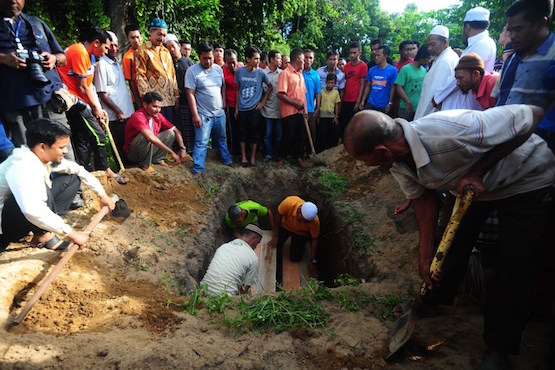
Relatives and mourners perform burial rites during a funeral for a father and his four-year-old daughter killed by a bomb blast in front of a school in the Takbai district of Thailand's restive southern province of Narathiwat on Sept. 6. An anonymous source from the separatist militant group Barisan Revolusi Nasional (BRN) has admitted responsibility for the deadly bombing. (Photo by AFP)

September 8, 2016


UCA News
The peace dialogue between the Thai government and separatist groups under the umbrella of Majlis Syura Patani (MARA Patani) has reached a critical juncture. The main hurdle is that ongoing violence on the ground has placed the government in a very awkward position.
Currently, Bangkok is not letting up with their demands that violence be subsided before they ink any agreement with MARA Patani. The problem is that Thai security officials believe that the group has little or no control over the militants behind a spate of attacks in the country, the most recent being a bombing outside a school in the restive south on Sept. 6. A father and his young daughter were killed in the attack allegedly carried out by insurgents.
A source from the Barisan Revolusi Nasional (BRN), the one group that controls the vast majority of combatants on the ground, admitted that its militants were behind the attack but expressed grave remorse at the death of the father and his child.
The target was the police, which BRN said were "legitimate," and that the bomb exploded half an hour after the school had already started, said the operative who spoke on condition of anonymity because he is not permitted to speak to the media.
There were also a recent car bomb attack at a major hotel and a powerful blast targeting a train. Both of these incidents were in the province of Pattani, the capital of the Malays' historical homeland.
About two million people reside in this historically contested region where about 85 percent are ethnically Malays who have a long standing mistrust of the Thai state and its policy of assimilation that they feel come at the expense of their cultural and religious identity. These two attacks were likewise carried out by the BRN.
It was BRN's way of letting both the Thai government and MARA Patani know of their disapproval of the ongoing peace initiative that was first launched by the government of Yingluck Shinwatra in February 2013 and continued by the current military government that ousted her in May 2014.
Even with Yingluck's initiative, which was kicked off by her fugitive brother former premier Thaksin one year before the official launch, BRN wasted no time to let Bangkok know that there is no short cut to peace. Two weeks after Thaksin met with 16 exiled leaders to convince them to come on board of a planned peace talk, BRN in late March 2012 set off a simultaneous triple car bomb in the heart of Yala, killing 14 people and injuring a further 130.

'Safety zone'
This year, the BRN demonstrated their displeasure of the peace initiative in March when scores of its combatants took over a hospital in Narathiwat province's Cho Ai Rong, one of the districts that Thailand wanted to be placed within a "safety zone." The hospital was used to stage a massive attack on a Paramilitary Ranger camp next door.
The safety zone initiative was Bangkok's way of determining whether MARA Patani could actually carry out unilateral ceasefire to demonstrate that it actually has command-and-control over the insurgents on the ground.
BRN wasted little time to demonstrate that MARA Patani doesn't have such control.
But the subject of the safety zones didn't go away and came up again in a Sept. 2 meeting between Thai negotiators and MARA Patani leaders. The heads of the umbrella organization had already suffered a great deal of humiliation last April when Thai Prime Minister Prayut Chan-ocha refused to give into their demands by signing a negotiated terms of reference that would make their dialogue official and a binding process.
Prayut said he was not able to do so because MARA Patani were associated with "criminals," a term he used in reference to the combatants on the ground. But in actuality, he, like other Thai officials, is waiting to see if MARA Patani could actually influence the course of violence on the ground.
Prayut further described the talk with MARA Patani as a burden that was created by the Yingluck government that was unfairly imposed on him.
And so when the topic of safety zone in the context of the public security came up at the Sept. 2 talks, BRN combatants chose the State Railway of Thailand as their target to discredit the peace initiative.
"You can't really get any more public than hitting a passenger train," said Suhaimee Dulasa, a youth activist from Patani Institute, a local civil society organization critical of the conduct of the state security apparatus.
Like previous attacks, BRN has shown some restraints and went for the carrier that wasn't carrying local passengers. One railway worker died from the blast and two other personnel were wounded.
A Thai military intelligence officer said BRN also employed the same practices when they set off a massive car bomb at a Pattani hotel on Aug. 23. The bomb, about 90 kilograms in weight, was meant to destroy the facility but not to rake up the body count.
Investigators pointed to a much smaller one that was set off 45 minutes earlier, about 100 meters away, which was supposed to be a warning to the people to leave the immediate area.
But while BRN said they do not endorse the ongoing talks between MARA Patani and the Thai government, it doesn't mean that they don't want to negotiate with Thailand.
BRN wants Bangkok to deal with them directly but they will come to the negotiating table only if they are properly prepared. This means the members of their political wing need to be more familiar with capacity building and understanding of international norms. These are basic requirements for them be recognized and accepted by Thailand and the international community.
The train blast occurred three weeks after a series of bombing incidents that killed four and wounded dozens in the seven provinces in the upper south, a region popular among foreign visitors and local tourists.
Unlike previous attacks outside of the conflict-affected region in the far south, BRN has been tight lipped about the attacks in the seven provinces and refrained to relay their message through the normal channel of communication to the policy makers in Bangkok.
BRN sources said the organization tends to react to something they don't like rather than issuing specific demands. Their mode of operation, for the time being, is to make the contested region ungovernable, as much as possible, until they are prepared to come to the negotiating table. This means Bangkok would have to permit the international community to recognize and work with BRN in the area of capacity building. Until then, Thailand can expect to see ongoing violence. 
Don Pathan is an associate with Asia Conflict and Security Consulting, Ltd. and is based in Yala, one of Thailand's three southernmost provinces hit by the current wave of insurgency.
